Comparing shuttle advertising vs traditional outdoor advertising starts with your audience, budget, and campaign goals. In today’s competitive business environment, getting your brand noticed is becoming increasingly challenging. Companies invest in multiple marketing channels to attract customers, increase visibility, and build a recognizable identity. Among these channels, outdoor advertising continues to offer opportunities for reaching audiences in public spaces.
However, the outdoor advertising landscape is evolving. While traditional formats such as billboards, hoardings, posters, and fixed-location displays remain popular, newer approaches such as 360° shuttle branding allow brands to connect with audiences through moving vehicles, interior promotional placements, digital screens, and interactive marketing.
For businesses operating in Delhi NCR, including Delhi, Dwarka, Noida, Gurugram, and Faridabad, choosing between shuttle branding and traditional outdoor advertising can significantly influence campaign planning and marketing budgets.
So, which advertising method is better?
The answer depends on your target audience, advertising objectives, budget, and desired customer engagement.
In this guide, we compare shuttle branding vs traditional outdoor advertising, examining their benefits, limitations, costs, targeting opportunities, and potential return on investment.
What Is Shuttle Advertising?
shuttle branding is a form of transit advertising in which businesses promote their products or services through passenger shuttle vehicles.
These vehicles may operate on corporate transportation routes, residential shuttle services, commercial routes, or other authorized passenger transportation networks.
Unlike fixed outdoor advertisements, shuttle advertisements can travel across multiple locations, allowing a brand to gain visibility along the vehicle’s operating route.
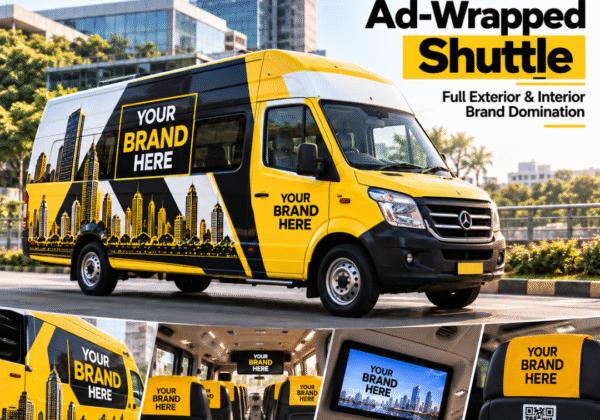
Modern 360° shuttle branding can also combine several advertising formats within a single vehicle.
Common Shuttle Advertising Formats
1. Exterior Shuttle Branding
Exterior advertising involves displaying promotional graphics, logos, product images, and marketing messages on the outside of shuttle vehicles.
Depending on the available vehicle inventory and permissions, advertising placements may include side panels, rear panels, and larger vehicle wraps.
2. Interior shuttle branding
Interior advertising allows brands to communicate with passengers through promotional placements inside shuttle vehicles.
These may include seat-back advertisements, headrest branding, interior panels, and other approved advertising spaces.
3. Digital Screen Advertising
Where onboard screens are available, businesses can display video advertisements, product demonstrations, promotional campaigns, and other digital content.
4. QR Code-Based Advertising
Shuttle advertisements can feature QR codes that direct passengers to websites, landing pages, promotional offers, registration forms, or online stores.
5. Integrated 360° Shuttle Campaigns
A 360° campaign combines multiple advertising placements to create a connected brand experience.
For example, a passenger might first notice a branded shuttle exterior, see additional information inside the vehicle, and scan a QR code to explore the advertised product.
Businesses interested in understanding this advertising approach can explore the detailed guide published by Ads On Cabs India on 360° shuttle branding in Delhi NCR, Dwarka, Noida, and Gurugram.
What Is Traditional Outdoor Advertising?
Traditional outdoor advertising, commonly referred to as out-of-home (OOH) advertising, includes promotional displays positioned in public spaces to reach people outside their homes.
These advertisements generally remain at a fixed location throughout the campaign.
Common examples include:
- Roadside billboards and hoardings
- Building-mounted advertisements
- Posters and commercial display boards
- Advertising kiosks
- Street furniture advertising
- Fixed promotional signage
Digital billboards are also part of the broader OOH industry, although they are generally categorized as digital out-of-home (DOOH) advertising.
Traditional outdoor advertising is frequently used for brand awareness, product launches, promotional campaigns, and location-specific marketing.
For example, a business opening a retail store in Gurugram might place a billboard near a major commercial road to introduce its brand to passing motorists and pedestrians.
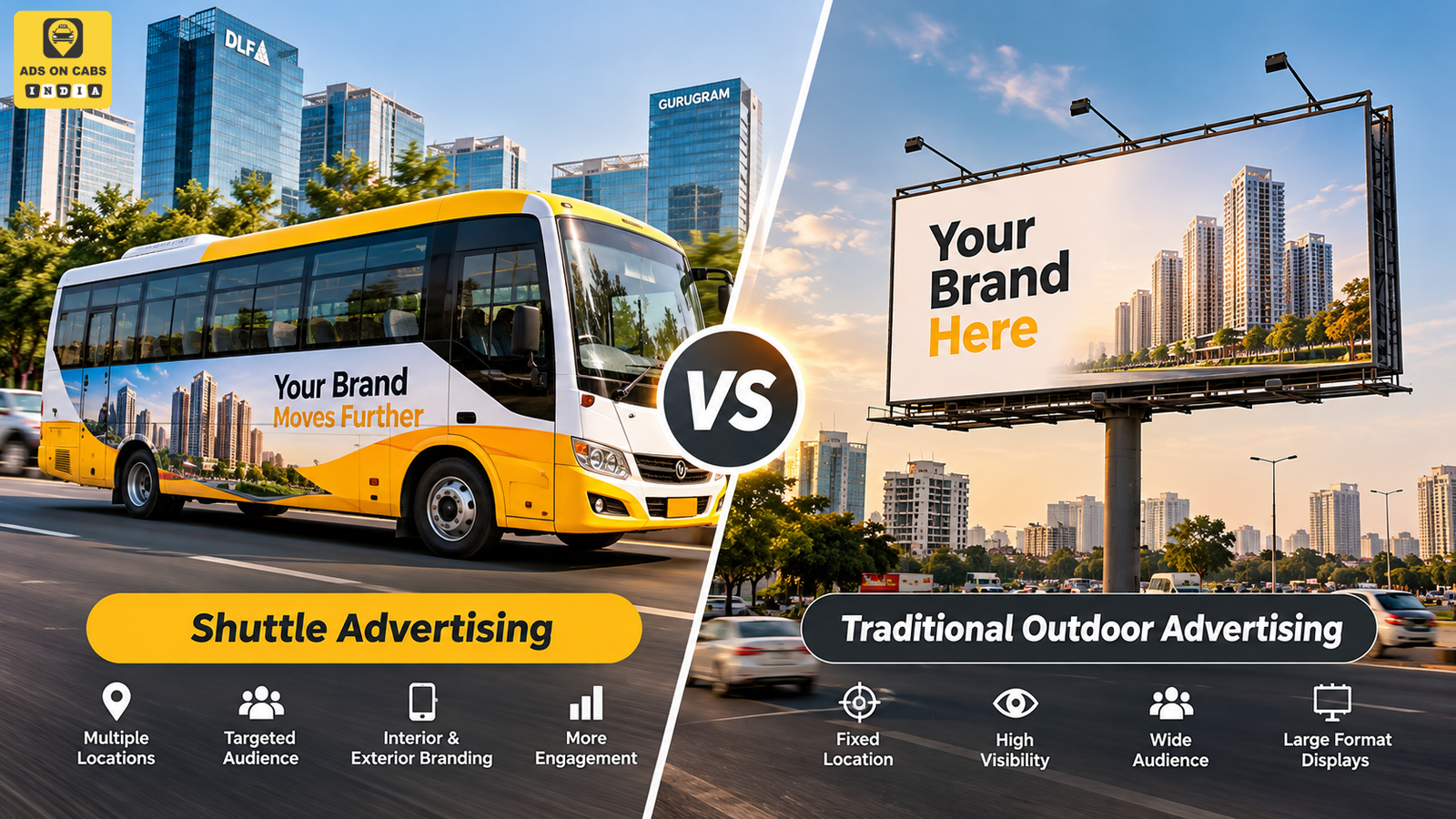
The main difference between traditional billboards and shuttle branding lies in how the advertisements reach their audiences.
A billboard remains at one location, while a branded shuttle can carry an advertisement across its scheduled operating route.
Shuttle Advertising vs Traditional Outdoor Advertising: Key Differences
Both formats offer valuable advertising opportunities, but their characteristics differ.
| Comparison Factor | Shuttle Advertising | Traditional Outdoor Advertising |
|---|---|---|
| Advertising location | Moves along operating routes | Usually fixed |
| Audience reach | Route-based exposure | Location-based exposure |
| Advertising formats | Exterior, interior, digital, QR codes | Billboards, posters, signage, digital displays |
| Passenger engagement | Possible through interior placements | Usually limited to viewing |
| Geographic targeting | Based on selected shuttle routes | Based on selected display locations |
| Campaign flexibility | Depends on vehicle inventory and agreements | Depends on display inventory and agreements |
| Digital integration | QR codes and onboard screens where available | QR codes and DOOH integrations where available |
| Visibility duration | Varies with routes and schedules | Depends on placement and contract duration |
| Performance tracking | Route reports, QR scans, enquiries | Traffic estimates, location data, QR scans |
| Best suited for | Route-based targeting and integrated engagement | Sustained visibility at strategic locations |
Neither format is universally superior. Their effectiveness depends on how well the placement aligns with the advertiser’s objectives.
1. Audience Reach: Mobile Advertising vs Fixed Visibility
One of the biggest differences between shuttle branding and traditional outdoor advertising is how each format reaches its audience.
How Shuttle Advertising Reaches Audiences
A branded shuttle can travel through multiple roads and neighbourhoods during its daily operations.
This creates opportunities for advertisements to be seen by pedestrians, motorists, commuters, and people in surrounding commercial or residential areas.
For example, a shuttle operating on an authorized route through Gurugram may provide advertising exposure at several points along its journey.
If the shuttle also contains interior advertisements, passengers may encounter additional brand messages during their commute.
However, actual reach depends on vehicle frequency, operating hours, route characteristics, traffic conditions, and the number of people who notice the advertisement.
How Traditional Outdoor Advertising Reaches Audiences
A billboard placed at a prominent intersection or major road can provide repeated visibility to people traveling through that location.
For businesses targeting a particular neighbourhood, this consistency can be highly valuable.
A strategically positioned billboard may also reach substantial traffic volumes, depending on its location and visibility.
Which Is Better?
shuttle branding may be preferable when a business wants exposure across several locations along a relevant transportation route.
Traditional outdoor advertising may be preferable when a business wants continuous visibility at one strategically important location.
2. Audience Targeting: Which Format Offers Better Precision?
Targeting the right audience is essential for an effective advertising campaign.
A large number of impressions does not automatically translate into valuable business opportunities.
Targeting Through Shuttle Advertising
Shuttle advertising can help brands focus on transportation routes associated with particular audience groups.
For example:
- A B2B software company might evaluate corporate shuttle routes.
- A coaching institute might consider routes used by students or working professionals.
- A real estate developer might select routes relevant to prospective property buyers.
- A retail brand might explore routes connecting residential and commercial areas.
This approach allows advertisers to plan campaigns around the geographic and contextual relevance of the audience.
Nevertheless, shuttle advertising does not guarantee that every person exposed to an advertisement belongs to the desired customer segment.
Targeting Through Traditional Outdoor Advertising
Traditional billboards offer location-based targeting.
A business can select advertising placements near shopping malls, commercial districts, residential neighbourhoods, or other relevant destinations.
For example, a restaurant advertising near its physical location may benefit from a billboard that directs nearby customers to the establishment.
Which Is Better?
Shuttle advertising is useful for route-based audience targeting, while traditional outdoor advertising is effective for fixed-location geographic targeting.
Businesses should choose the format that best matches their intended customer journey.
3. Advertising Cost: Is Shuttle Advertising More Affordable?
Advertising cost is often a major consideration for businesses planning outdoor marketing campaigns.
However, comparing shuttle advertising and traditional outdoor advertising solely on price can be misleading.
Factors Affecting Shuttle Advertising Costs
The cost of shuttle advertising may depend on:
- Number of vehicles selected
- Advertising placement and size
- Exterior wrapping or printing requirements
- Interior advertising inventory
- Availability of digital screens
- Campaign duration
- Operating routes and locations
- Installation, maintenance, and removal expenses
Factors Affecting Traditional Outdoor Advertising Costs
Billboard and hoarding advertising costs may depend on:
- Display location
- Billboard dimensions
- Traffic volume and visibility
- Illumination or digital display technology
- Campaign duration
- Printing and installation expenses
- Availability of premium advertising inventory
Which Offers Better Value?
A single shuttle campaign and a premium roadside billboard are not directly comparable without examining the actual quotations and expected exposure.
Advertisers should compare total campaign costs, audience relevance, estimated reach, and measurable outcomes.
A lower-cost campaign is not necessarily more effective if it fails to reach the intended audience.
The better advertising investment is the one that delivers relevant exposure and supports the campaign’s business objectives within the available budget.
4. Brand Visibility: Which Creates Stronger Recognition?
Brand recognition develops when audiences repeatedly encounter a consistent visual identity and marketing message.
Both shuttle advertising and traditional outdoor advertising can contribute to this process.
Brand Visibility Through Shuttle Advertising
Shuttle advertising can introduce a brand across multiple points along a vehicle’s route.
The moving format may attract attention in traffic, near offices, or around residential and commercial destinations.
Interior placements can reinforce the same message among passengers.
For example, an exterior advertisement may introduce a product, while an interior advertisement provides more detailed information about its benefits.
Brand Visibility Through Traditional Outdoor Advertising
A billboard positioned at a major intersection can become a recognizable visual landmark.
People regularly traveling through that location may encounter the same advertisement repeatedly.
Large-format billboards can also communicate brand messages through prominent visuals and minimal text.
Which Is Better?
Shuttle advertising offers opportunities for brand exposure across a route.
Traditional outdoor advertising offers sustained visibility at a fixed location.
For maximum brand consistency, businesses can use the same campaign identity across both formats.
5. Customer Engagement: Can Shuttle Advertising Offer More Interaction?
One potential advantage of 360° shuttle advertising is its ability to combine physical brand visibility with passenger-facing promotional experiences.
Interactive Shuttle Advertising
Depending on the available vehicle configuration, shuttle campaigns can include:
QR codes: Passengers can scan a code to visit a campaign website, explore a product, or access a promotional offer.
Digital screens: Brands can display videos and other promotional content.
Interior advertising: Seat-back advertisements and promotional panels can communicate more detailed information than a moving exterior advertisement.
Dedicated landing pages: Businesses can direct interested passengers to campaign-specific online destinations.
These features can create additional opportunities for interaction beyond simply viewing an advertisement.
Engagement Through Traditional Outdoor Advertising
Traditional billboards primarily communicate through visual exposure.
However, fixed outdoor advertisements can also include QR codes, memorable URLs, promotional codes, and digital campaign integrations.
Digital billboards may offer additional creative capabilities.
Which Is Better?
A 360° shuttle campaign may provide more opportunities for direct passenger interaction when interior advertising and digital engagement formats are available.
Traditional outdoor advertising remains effective for delivering simple, memorable messages to broad audiences.
6. Campaign Measurement: Which Is Easier to Track?
Businesses increasingly want to understand how their advertising investments contribute to marketing performance.
Both shuttle advertising and traditional outdoor advertising require thoughtful measurement.
Measuring Shuttle Advertising
Possible measurement methods include:
- GPS-based route documentation, where available
- Vehicle deployment reports
- Installation photographs
- QR-code scans
- Campaign landing-page traffic
- Promotional code redemptions
- Customer enquiries
GPS tracking can help verify vehicle movement, but it does not directly measure how many people viewed an advertisement.
Similarly, QR-code scans indicate interaction rather than confirmed purchases.
Measuring Traditional Outdoor Advertising
Traditional outdoor advertising may be evaluated through:
- Location-based audience estimates
- Traffic and pedestrian movement data
- Visibility assessments
- Campaign execution reports
- QR-code scans
- Brand awareness research
- Enquiry and sales attribution methods
Which Is Better?
Shuttle advertising may provide additional route-level reporting and passenger engagement indicators.
Traditional outdoor advertising may benefit from established location-based audience estimation methods.
The availability and reliability of measurement data should be confirmed with the advertising provider before booking a campaign.
7. Shuttle Advertising vs Billboards in Delhi NCR
Delhi NCR includes a wide range of business environments, from residential communities to major commercial districts.
Advertising strategies should reflect the characteristics of each location.
Shuttle Advertising in Dwarka
Dwarka contains residential communities, retail establishments, educational institutions, and service businesses.
Shuttle advertising may help businesses communicate with audiences traveling along relevant local transportation routes.
Traditional billboards can complement this approach by providing fixed visibility near important commercial destinations.
Shuttle Advertising in Noida
Noida includes corporate offices, technology companies, educational institutions, shopping destinations, and residential developments.
Businesses can evaluate shuttle routes relevant to office commuters and other target audiences.
Billboards may be useful when the objective is prominent visibility at selected commercial locations.
Shuttle Advertising in Gurugram
Gurugram is an important corporate and commercial market within Delhi NCR.
Businesses targeting office professionals can explore suitable corporate shuttle advertising opportunities.
Traditional outdoor advertising may be valuable for campaigns requiring prominent visibility along major roads or commercial corridors.
Shuttle Advertising in Faridabad
Faridabad offers advertising opportunities associated with residential, industrial, and commercial markets.
Businesses can compare available shuttle routes with fixed outdoor advertising locations based on their customer profiles.
In every market, advertisers should verify available routes, advertising inventory, local regulations, and placement permissions.
8. Which Industries Can Benefit From Shuttle Advertising?
Shuttle advertising can be considered by businesses across several industries.
Real Estate
Real estate developers can use exterior branding to introduce residential or commercial projects.
Interior advertisements and QR codes may direct interested passengers to project information or enquiry forms.
Education
Universities, coaching institutes, and professional training providers can evaluate shuttle routes relevant to prospective students and working professionals.
Healthcare
Hospitals, diagnostic centres, and healthcare providers may use shuttle advertising to build awareness of services, locations, and appointment channels.
Retail and E-Commerce
Retail brands can promote product launches, store openings, seasonal campaigns, and online shopping destinations.
Financial Services
Banks, insurance companies, and fintech businesses can use shuttle branding to communicate financial products and services, subject to applicable advertising requirements.
Technology and B2B Services
Technology companies and professional service providers can consider corporate transportation routes as part of campaigns aimed at relevant business audiences.
The suitability of shuttle advertising depends on the advertiser’s target market and the actual transportation routes available.
9. When Should You Choose Traditional Outdoor Advertising?
Traditional outdoor advertising may be the stronger choice when:
- Your business wants prominent visibility at a specific location.
- You are promoting a store or service near a major road.
- Your campaign requires a large-format visual display.
- You want to establish a recognizable presence in a particular commercial district.
- Your intended audience regularly passes through the selected location.
For example, a shopping mall promoting a seasonal sale may find a well-positioned billboard useful for reaching people traveling near the property.
10. When Should You Choose 360° Shuttle Advertising?
Shuttle advertising may be more suitable when:
- Your target audience uses identifiable transportation routes.
- You want brand visibility across multiple locations.
- You want to combine exterior and interior advertising.
- Your campaign includes QR-code engagement or digital content.
- You want to reach passengers with more detailed promotional messages.
- You are planning an integrated transit advertising campaign.
For example, a business promoting professional training programmes might combine shuttle exterior branding with interior advertisements directing interested passengers to an online registration page.
11. Can Shuttle Advertising and Traditional Outdoor Advertising Work Together?
Yes. In many cases, combining both formats can create a more comprehensive outdoor marketing campaign.
Consider a hypothetical real estate company launching a residential project in Delhi NCR.
The company could use a billboard near the project location to create a prominent visual presence.
At the same time, shuttle advertisements could communicate the project’s branding along selected transportation routes.
Interior advertisements might direct passengers to a website containing project details, while digital marketing campaigns could retarget eligible audiences who have independently engaged with the brand online.
This approach connects fixed-location awareness, mobile visibility, and online customer engagement.
However, the advertiser should assess whether the additional channels provide incremental value rather than duplicating the same audience unnecessarily.
12. How to Choose the Right Outdoor Advertising Strategy
Before selecting shuttle advertising or traditional outdoor advertising, businesses should answer five important questions.
What is the primary objective?
Determine whether the campaign aims to generate brand awareness, website traffic, enquiries, store visits, or sales.
Who is the target audience?
Identify the locations, customer characteristics, and transportation patterns relevant to the advertised product or service.
What is the available budget?
Compare complete campaign quotations, including production, installation, media placement, maintenance, and reporting costs.
What message needs to be communicated?
A short, memorable brand message may work well on a billboard or vehicle exterior.
More detailed promotional information may be better suited to interior advertisements or linked digital content.
How will success be measured?
Establish relevant performance indicators before launching the campaign.
These may include verified placement delivery, audience estimates, website visits, qualified enquiries, or other campaign-specific outcomes.
13. Explore 360° Shuttle Advertising With Ads On Cabs India
Businesses interested in exploring transit advertising opportunities can learn more about the integrated shuttle branding concept presented by Ads On Cabs India.
The approach brings together exterior shuttle advertising, interior promotional placements, onboard digital content, and QR-based engagement.
For companies evaluating advertising opportunities in Delhi NCR, understanding these formats can help in selecting an appropriate campaign strategy.
Explore the complete guide:
360° Shuttle Advertising in Delhi NCR, Dwarka, Noida & Gurugram — Ads On Cabs India
You can also visit www.AdsOnCabs.com to explore outdoor and transit advertising services.
Conclusion: Shuttle Advertising vs Traditional Outdoor Advertising — Which Is Better?
There is no single advertising format that delivers the best results for every business.
Traditional outdoor advertising is particularly useful when a brand needs sustained visibility at a prominent, fixed location.
Shuttle advertising offers an alternative approach by taking promotional messages across transportation routes and, where supported, combining exterior branding with interior advertising and digital engagement.
For businesses targeting office commuters, residential communities, and commercial audiences in Delhi NCR, 360° shuttle advertising may offer a useful combination of mobile visibility and customer interaction.
Ultimately, the right choice depends on audience relevance, campaign objectives, budget, creative execution, and measurement capabilities.
Rather than asking which advertising format is universally better, businesses should identify which format is better suited to reaching their customers.
And for campaigns requiring both geographic prominence and route-based exposure, combining shuttle advertising with traditional outdoor advertising may provide a more complete marketing approach.
Frequently Asked Questions (FAQs)
1. What is the main difference between shuttle advertising and traditional outdoor advertising?
Shuttle advertising places promotional messages on passenger vehicles that operate along transportation routes. Traditional outdoor advertising generally uses fixed displays such as billboards, hoardings, and posters.
2. Is shuttle advertising cheaper than billboard advertising?
Not necessarily. Costs depend on vehicle inventory, advertising formats, campaign duration, production requirements, billboard location, and other factors. Advertisers should compare actual quotations.
3. Is shuttle advertising effective for brand awareness?
Shuttle advertising can support brand awareness by displaying promotional messages along vehicle routes. Effectiveness depends on audience relevance, campaign frequency, creative design, and execution.
4. Can shuttle advertising generate leads?
Yes, shuttle campaigns can include QR codes, landing pages, and promotional offers designed to encourage enquiries. Actual lead generation depends on the campaign and audience response.
5. Which locations are suitable for shuttle advertising in Delhi NCR?
Businesses can explore available routes in Delhi, Dwarka, Noida, Gurugram, Faridabad, and other relevant areas. Route availability and advertising permissions should be confirmed before campaign planning.
6. Can digital advertisements be displayed inside shuttle vehicles?
Yes, where compatible onboard screens and advertising permissions are available, digital advertisements may be displayed inside shuttle vehicles.
7. How can businesses measure shuttle advertising performance?
Possible indicators include vehicle deployment reports, route documentation, QR-code scans, website analytics, promotional redemptions, and customer enquiries.
8. Is shuttle advertising suitable for small businesses?
It can be, provided the available routes, campaign costs, and target audience align with the business’s marketing objectives.
9. Can shuttle advertising and billboard advertising be used together?
Yes. Businesses can combine fixed-location outdoor displays with mobile shuttle branding to support a coordinated advertising strategy.
10. How can I explore shuttle advertising services in Delhi NCR?
Visit Ads On Cabs India to learn more about available outdoor and transit advertising solutions.
For practical campaign tracking, see Google Analytics guidance on campaign URL parameters.