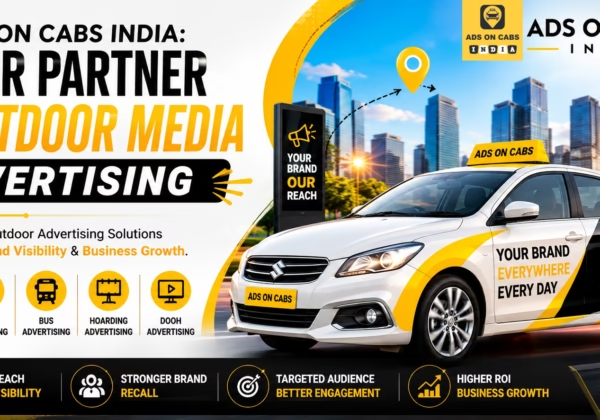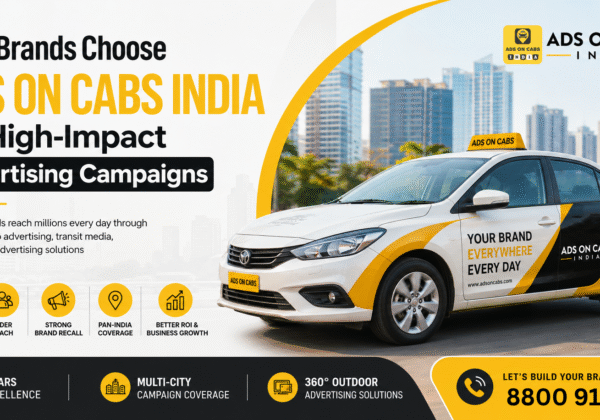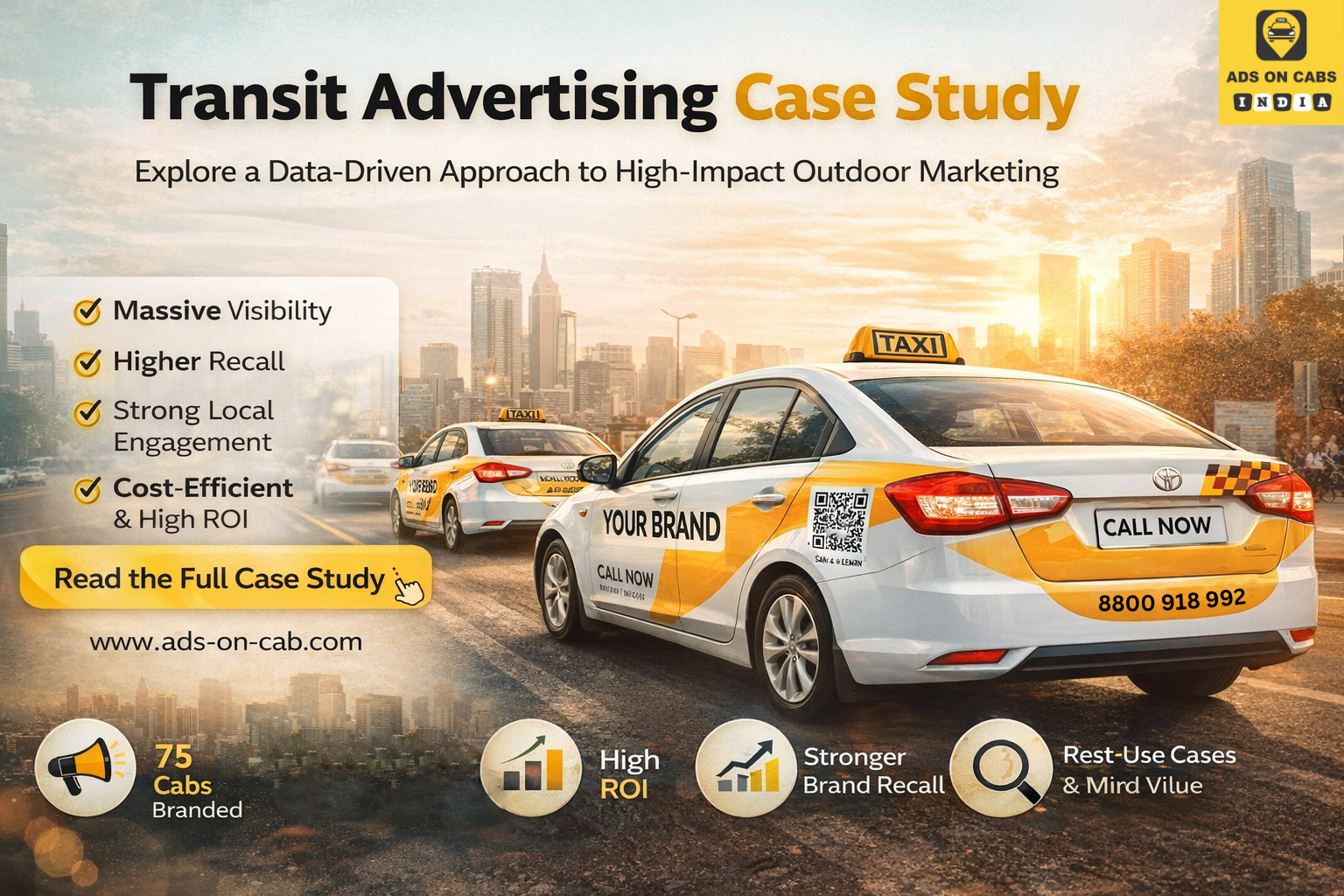

In an era where consumers are constantly on the move, brands need advertising that moves with them. Transit advertising—branding on cabs, autos, and buses—has emerged as one of the most effective, scalable, and cost-efficient outdoor advertising solutions in India. Unlike static formats, this medium allows brands to travel across the city, ensuring repeated exposure to diverse audiences throughout the day.
This detailed case study explores how a well-planned cab advertising campaign delivered measurable results in terms of reach, recall, engagement, and return on investment.
Understanding Transit Advertising
Transit advertising refers to placing advertisements on moving vehicles such as app-based cabs, auto rickshaws, buses, and even delivery fleets. These vehicles act as mobile billboards that continuously circulate across different parts of a city.
The biggest advantage of this format is its ability to combine mobility with visibility. Instead of being limited to a single location like a billboard, transit ads reach audiences in multiple areas, including business districts, residential neighborhoods, and commercial hubs. This makes it particularly effective in densely populated cities where people spend significant time commuting and are constantly exposed to outdoor media.
Campaign Overview
The campaign featured in this case study was executed for a mid-sized consumer brand operating in a highly competitive urban market. The primary objective was to increase brand awareness and strengthen the brand’s presence across key locations in a metro city such as Delhi, Mumbai, or Bangalore.
The campaign was designed to run for a duration of 30 days, during which a fleet of 75 branded cabs was deployed. These cabs were wrapped with high-quality vinyl creatives that ensured durability and visual impact. The campaign aimed not only to maximize visibility but also to create consistent and repeated exposure among the target audience.
The Core Challenge
The brand was facing increasing competition in the urban marketplace, where multiple players were already investing heavily in advertising. Traditional media channels such as billboards and digital ads were either too expensive or lacked the desired impact due to clutter and oversaturation.
Another major challenge was the need for hyperlocal targeting. The brand wanted to connect with consumers in specific high-traffic zones without overspending on mass media. Therefore, the requirement was clear: a solution that could deliver high visibility, strong recall, and targeted reach while remaining cost-effective.
Strategy & Planning
To address these challenges, a carefully structured transit advertising strategy was developed. The planning phase focused heavily on identifying the right locations, designing impactful creatives, and ensuring optimal vehicle movement across the city.
Route intelligence played a crucial role in the campaign. High-footfall areas such as corporate hubs, shopping malls, metro stations, and residential clusters were mapped out to ensure that the branded vehicles would consistently pass through locations with maximum audience density.
In terms of creative execution, the designs were kept bold, visually striking, and easy to read even from a distance. Since the vehicles were in motion, it was important to minimize text and focus on strong branding elements that could capture attention within seconds.
Fleet deployment was also strategically managed. The 75 cabs were distributed across different city zones to ensure balanced coverage. Each vehicle operated during peak hours as well as regular traffic hours, maximizing exposure throughout the day.
Estimated Campaign Reach & Metrics
The campaign delivered impressive reach due to the continuous movement of vehicles across high-traffic areas. On average, each cab generated between 25,000 to 40,000 impressions per day, depending on the routes and traffic conditions.
With a fleet of 75 cabs, the total daily impressions ranged between approximately 18 to 25 lakh. Over the course of 30 days, the campaign achieved an estimated reach of 5 to 7 crore impressions.
In addition to visibility metrics, there were noticeable improvements in engagement indicators. The brand experienced an increase in search queries, higher website traffic (especially through QR code interactions), and improved social media mentions. These signals indicated that the campaign was not only reaching people but also driving interest and action.
Cost vs ROI Analysis
One of the most significant advantages of transit advertising is its cost efficiency. Compared to traditional hoardings, the cost of running a transit campaign is relatively lower while offering broader coverage.
In this case, the cost per impression was significantly reduced due to the high volume of daily exposure. The repeated visibility ensured that the audience encountered the brand multiple times, which helped in building stronger recall.
As a result, the campaign delivered a high return on investment. The combination of affordability, reach, and frequency made transit advertising a more efficient choice compared to static outdoor media.
Consumer Behavior Insights
The success of transit advertising can be attributed to how people interact with moving visuals in real-world environments. Human attention is naturally drawn to movement, which makes mobile ads more noticeable than static ones.
Additionally, repeated exposure plays a key role in influencing consumer behavior. When people see the same brand multiple times during their daily commute, it creates familiarity and trust. Unlike digital ads that can be skipped or ignored, transit ads become part of the consumer’s everyday environment, making them harder to overlook.
This combination of visibility, repetition, and real-world presence contributes to stronger brand recall and recognition.
Key Results Achieved
The campaign successfully delivered large-scale brand visibility across the city, ensuring that the brand remained consistently present in the minds of consumers. The repeated exposure helped improve recall rates, making it easier for the audience to remember and recognize the brand.
There was also a noticeable increase in local market penetration, as the campaign targeted key zones where the brand wanted to establish a stronger presence. In addition, the campaign contributed to increased footfall and online engagement, demonstrating its effectiveness in driving both awareness and action.
Overall, the campaign proved to be a cost-effective and high-impact marketing solution.
Transit Advertising vs Other Media
When compared to traditional advertising formats, transit advertising stands out due to its dynamic nature. While billboards remain fixed in one location, transit ads move across multiple areas, offering wider coverage.
Digital advertising, on the other hand, often suffers from ad fatigue and low attention spans, as users tend to skip or ignore ads. In contrast, transit advertising operates in the physical world, where it naturally captures attention without interrupting the user experience.
This makes transit advertising a powerful complement to digital campaigns, helping brands achieve both online and offline visibility.
Transit Advertising vs Other Media
| Parameter | Transit Ads | Billboards | Digital Ads |
|---|---|---|---|
| Reach | Wide & mobile | Fixed | Targeted |
| Cost | Moderate | High | Variable |
| Visibility | High | Medium | Scroll-based |
| Recall | Strong | Moderate | Low (skippable) |
| Engagement | Real-world | Passive | Click-based |
Best Use Cases for Transit Advertising
Transit advertising is particularly effective for brands that want to reach a large urban audience within a short period. It works well for industries such as FMCG, food delivery, e-commerce, real estate, and mobile applications.
It is also highly suitable for product launches, promotional campaigns, and brand awareness drives. Businesses that rely on local customers can benefit greatly from the hyperlocal targeting capabilities of transit media.
Future of Transit Advertising in India
The future of transit advertising in India looks extremely promising. With increasing urbanization and rising traffic levels, the number of vehicles on the road continues to grow, creating more opportunities for mobile advertising.
Brands are also beginning to integrate transit campaigns with digital technologies such as QR codes and location-based tracking, making campaigns more interactive and measurable.
As marketing strategies evolve, transit advertising is expected to become a key component of integrated campaigns, offering a perfect balance between reach, visibility, and cost efficiency.
Conclusion
This transit advertising case study clearly demonstrates that mobility-driven marketing can deliver exceptional results when executed strategically. By combining high visibility, repeated exposure, and cost efficiency, transit advertising provides a powerful platform for brands to connect with their audience.
For businesses looking to maximize their marketing impact without overspending, transit advertising offers a smart and future-ready solution.
Start Your Campaign Today
If you’re looking to achieve similar results and take your brand visibility to the next level, transit advertising could be the perfect solution for you.
🚖 Contact Ads On Cabs for customized, high-impact advertising campaigns
🌐 www.ads-on-cab.com